
Dashboard › Channels › Body Language › Body Language Breakdown | Read the BEET | Expressions Reveal Emotions
Tagged: beet, body language, breeds, emotions, expressions
-
Body Language Breakdown | Read the BEET | Expressions Reveal Emotions
Posted by Catherine Comden on April 18, 2023 at 9:57 amJust LOOK at those faces! They tell us so much.
Dogs have rich emotional lives and their faces reveal their feelings. Dogs have fewer facial muscles than we do, so it can be trickier to see their expressions. Lots of facial fuzz, different eye shapes and other breed differences can make it tough to see changes in expressions.
But the brain science is clear; dogs have similar responses to our own, in similar conditions. They feel excitement, happiness, sorrow, disappointment, sadness, anger and rage. And it’s all readable on their faces.
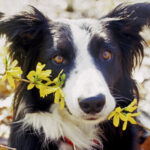
Drop a facial photo of your dog here and tell us the situation. Did you capture them expressing joy, confusion, boredom or something else? We’d love to see it!
 Catherine Comden replied 3 years, 4 months ago 4 Members · 15 Replies
 -
15 Replies
-

Two very different moments of emotion for Bliss, my 1yo Aussie.
On the left, notice her rounded eyes, her closed muzzle with tense lips.
On the right, she has almond eyes, long lips, relaxed tongue.
(And that’s not even mentioning her ears and body tension.)
On the left, she was pleading with me to stop staring at my screen (never mind it pays for her kibble). On the right, she was anticipating a cookie for practicing DOWN in the tornado shelter. A happy place!
-

Here are two pictures of Wai. What do you guys think is happening?
-
Or for more interesting face photos, here are these too. ????
-
Does he always have a happy smile and soft eyes?! Those ears, though! They tell a story!
-
-
-

I saw this as more of an agonistic pucker- to me the lips are pulled more forward “c” shape vs. longated and pulled back, wider eyes vs squinty and crinkled nose. More canine teeth than front. Hmmmmm.
This is what I think of as a submissive grin.
-
I agree the photo you submitted is a more exaggerated grin. The one @virginiad shared is also a submissive grin.
Here’s where reading the BEET can really help, especially in real time.
Body – the dog is not aligned straight, but curved. A good sign that this is not a distance-increasing behavior. An arc in a dog’s body, especially when accompanied by wiggles and looseness is pro-social. We can’t see the whole body here, but I don’t see anything that looks like tension.
Ears – OMD those curled ears though. When a dog is peeling back their flaps to make their inner ear accessible, it’s always pro-social. If this dog were fearful or feeling defensive, those ear flaps would be closed, and flat to the head. If the dog were feeling offensive, the ears would be pricked forward and you’d see triangles. Curled back ear flaps make me squishy inside, in a good way!
Expression – now we can look at eyes, lips, nostrils, muzzle, forehead. We’re going to be breaking this down on the 25th in our LIVE – with lots of examples. In this photo the first thing I noticed was the softness of the eyes. There is no tension around the lids and no white. There are not ridges above the eye – no “dialing in” which would indicate a distance-increasing gaze. The lips are asymetrical, but the more exaggerated side of the mouth shows long lips. If this were a snarl, the lips would be very short. The whiskers are neutral or pulled back in the grin, not pushed forward like porcupine quills.
Tail – of course we can’t see the tail, but if I had to guess, this tail would be midline or lower and almost definitely wagging.
Hope this helps – and I cannot wait to get into this type of deconstruction more during our LIVE on Tuesday! Hope you can make it!
-
Thanks for this info!
“When a dog is peeling back their flaps to make their inner ear accessible, it’s always pro-social” I have never heard of this! I think this may also be one of those subtleties that come with experience to “see” in all the different breeds.
Well, at least I would not have been bit since I would have given this dog space without knowing the context and seeing the entire body!
I will try to capture my cousin’s dog grin. His body is so loose and wiggly with neck/head turns and tosses- it is a show for sure.
Which bring me another question. Are some grins for submission/fear contexts and, some likely for greeting in a positive way, correct? Context is important for these displays, too?
Thanks!
-
Great, Jen – yes, I think I learned that open ear thing along the way after greeting hundreds of dogs. I remember noticing it and then paying attention to it for a long while before teaching it. I see dogs with different ear shapes have variations on that theme, but it is easiest to see in small flap ears.
And YES – I think greetings can be pro-social/confident and include a grin. I do still think “appeasement” is hard wired as it seems the super-squishy toothful grins happen most with the soft-personality dogs, not the knee-cap busters. Those guys are smiling but it’s the WHOLE MOUTH, not just the teeeeeth. 😉
-
-
-
-
My cousin’s dog displays submissive grins all the time when people come in the front door. I will have to see if I can capture some nice video of it! He is on the low confidence side but seems to enjoy the company of all people and all dogs.
-
ooo yes please!
That teeth-flashing in real time can be concerning when you don’t know the dog and miss the other body signals. I’d LOVE video of this to help people learn.
-
-
Sometimes it helps to look at a comparable human expression. We’re going to be doing a bunch of this next week. Here’s a quick sample for agonistic pucker. Notice not only the short lips, but the hard eyes and furrowed brow in both photos.
Log in to reply.