
Dashboard › Channels › Other Dog Topics › Parallel Universe
Tagged: body_language, cats, multi_dogs, parallel_behavior
-
Parallel Universe
Posted by David Muriello on September 24, 2021 at 11:52 amI loved how @Catherine pointed out the parallel behavior of @Chris ‘s dogs in this post. Here’s some parallel cuddling and more by Hazel and Lido. They are lined up all the time in so many different situations, not just resting. It is so cool.
The middle photo is when we were at an Air BnB and they were barking at sounds from the apartment below so I had a bag of treats out while I worked to reward quiet Down-Stays. Rewards came every time there was a “bump” sound from downstairs and they didn’t bark. They stopped alerting to the sounds after ten minutes. Anyone want to share the name of this technique?
If I find other interesting examples I’ll share them and if you guys have any, share the parallels! Paula Mrazek replied 4 years, 10 months ago 6 Members · 12 Replies
 -
12 Replies
-

These are cool photos, David, thanks for sharing. Parallel behavior is so darn companionable. I hope people have lots of photos of this – once you start looking for it, it’s everywhere among dogs who get along. I have even seen it across the feline-canine spectrum…. off to look for photos!!
-
All of these photos were taken by friends and shared with me for the purpose of teaching various things… and as I went looking through my files for examples of parallel behavior, it struck me that we often notice it when the animals are at rest – though, in the first photo, that’s not the case!
The last two pictures (and so many more like them – who among us has not posed a bunch of dogs for a photo op?) made me consider this question:
If parallel behavior is a signal between two or more dogs of affiliation, relaxation, companionship... when we cue parallel behavior, such as in a training exercise or for a photo… what, do you think the dogs are feeling about it?
What things might we need to consider when asking dogs to “line up?”
-
-
I do have some photos of feline-canine parallel behavior via my dog Amber and cat Yoru! Most of their parallel behavior is resting or cuddling related as @Catherine mentioned. The first photo is a common position you’ll find them in. The second photo with that has two dogs is Amber, my old roommate’s dog Diaz, and Yoru. The last one is Yoru and Amber both curled up on the couch on a chilly day. I also have a photo of Amber and Diaz displaying some parallel behavior on their own – it was so cute I had to decorate the photo!



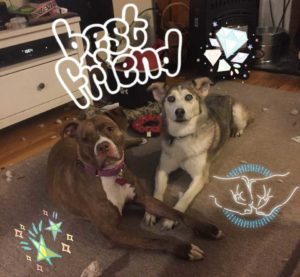
-
-

Great pics all. I really love the three sheps on the sofa. That is such a kodak moment.
-
-

Wow, Catherine and Cait… Amazing shots. The two Goldens falling off the couch! ????
And the cross species example with the cat is so cool.
-
@David , was that technique differential reinforcement? If not, I didn’t mean that and I will blame autocorrect.????
-
Way to jump into the game, @Brian ! (I like your sense of humor, too.)
First off, let me say that the “labeling” game here is just for fun and learning. Being able to place methods into strict labels is not as important as discovering how and why methods work. I see discussions about labeling as very interesting, but also just a way to fill your mind with creative solution possibilities because you grow to understand them better. (You become more fluent.) In practice, training methods often overlap and blend into hazy lines that go beyond the definitions of strict labels.Labels are for books and conversations. Methods are for real world communication and interaction with the animals – where real change happens in the moment.
Okay, now I definitely see why you went with differential reinforcement because “differential reinforcement involves providing either positive or negative reinforcement for a targeted response” and you could argue that I was looking to reward silence (non-barking) and other calm behaviors (staying in a down rather than running around the room looking for the source of the banging). But “differential reinforcement is a two-part process – reinforcing the desired response(s) and extinguishing all other responses” and I was not just ignoring all other responses. I was directing the dogs into a specific behavior (Down/Stay, near me) and if they barked I wasn’t just waiting for extinguishment, I was giving them something else to try by cueing the Down. (My dogs are much less likely to bark or get aroused in a Down).
So I would call this counter-conditioning and I used both types in a blended method here. First, I used operant counterconditioning – rewarding an alternate behavior: If you come over here and lie down, you’ll get a treat. Then, I focused on the sound trigger. After a minute or so of treats for Down-Stay with duration, they didn’t just get treats for lying down and staying, they only got treats when the banging sounds happened.
So now we are into…
Classical counterconditioning – changing the emotional association with the sound. Banging sound = treats. After that, we continue with a blended approach and raised criteria – the banging sound equals treats IF you stay quiet in a Down. After ten minutes the dogs were not just performing, they were actually relaxed in their Down Stays (heads dropped to the floor in between treats). Each time the banging sound happened they would lift their heads and look at me for a treat (conditioning has taken place). They stopped alerting to the sounds even after I released them from the Down and stopped the treat tossing. We all had a peaceful night.
-

My pups often rested together. It is such a cool thing to see all the great pictures from everyone!
Here’s a couple more!
-
This is what they do! Beautiful, peaceful pups Paula. ????
-
Log in to reply.